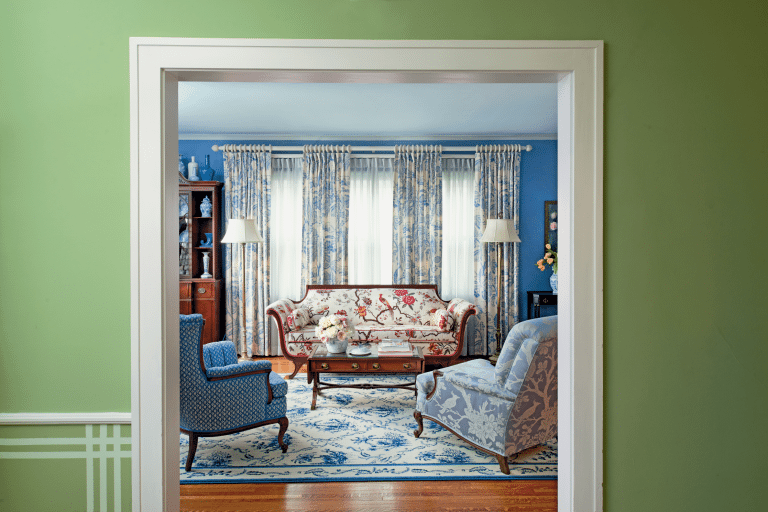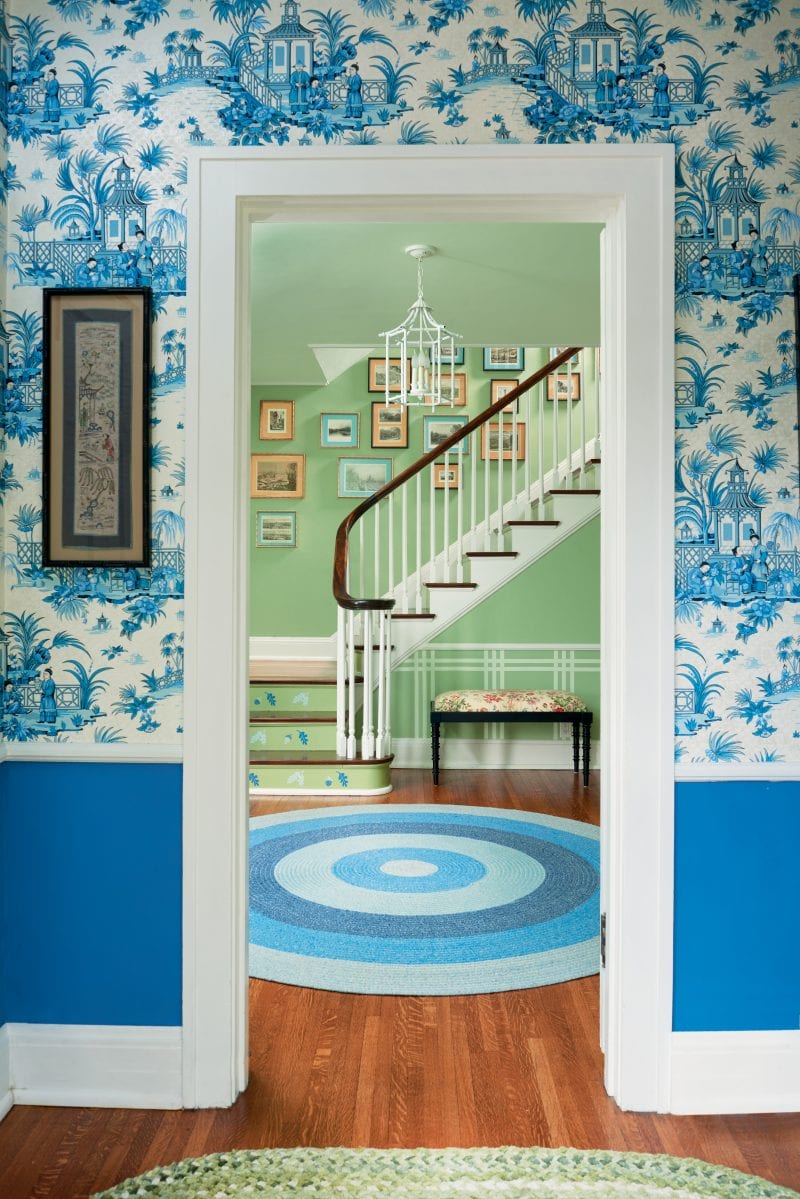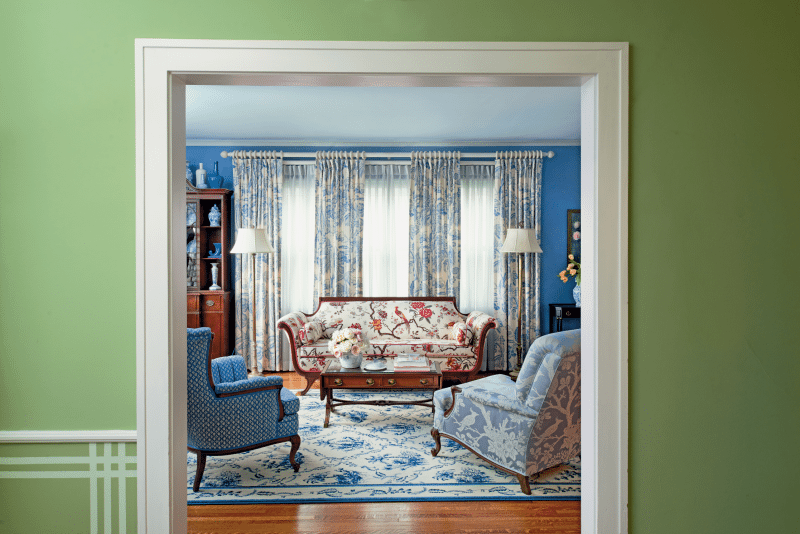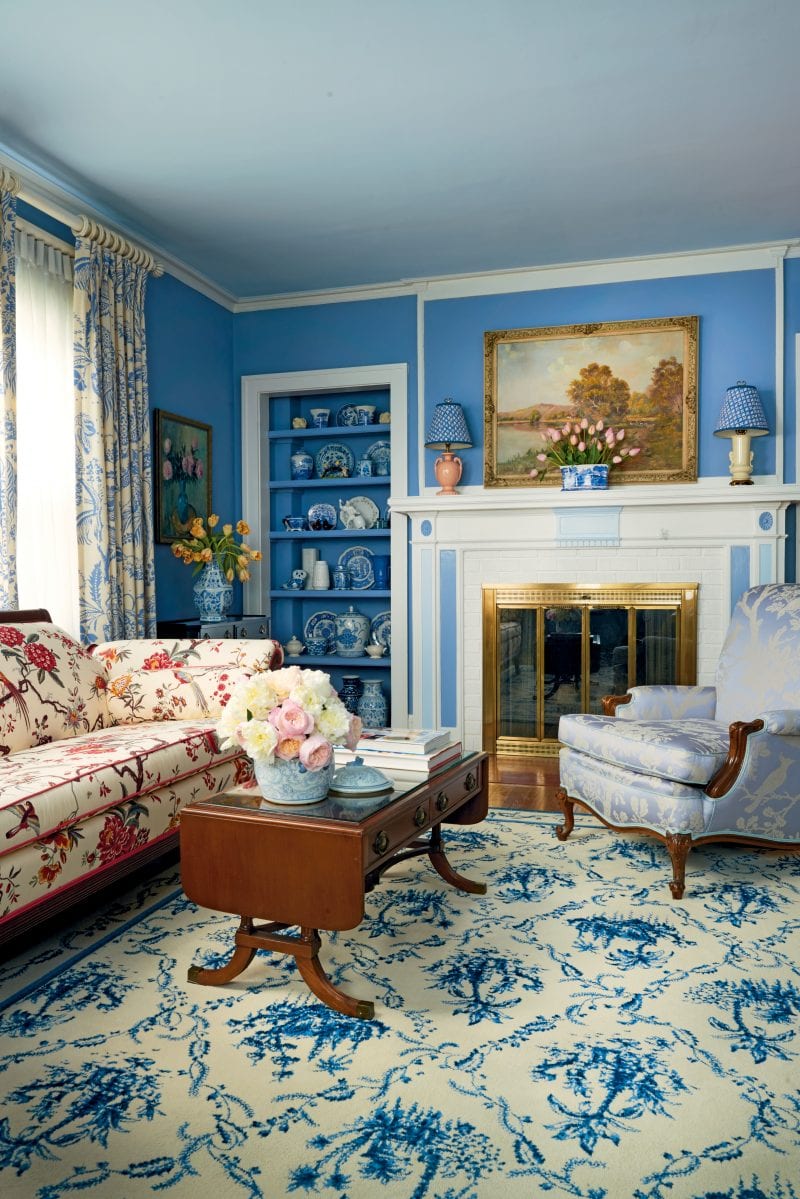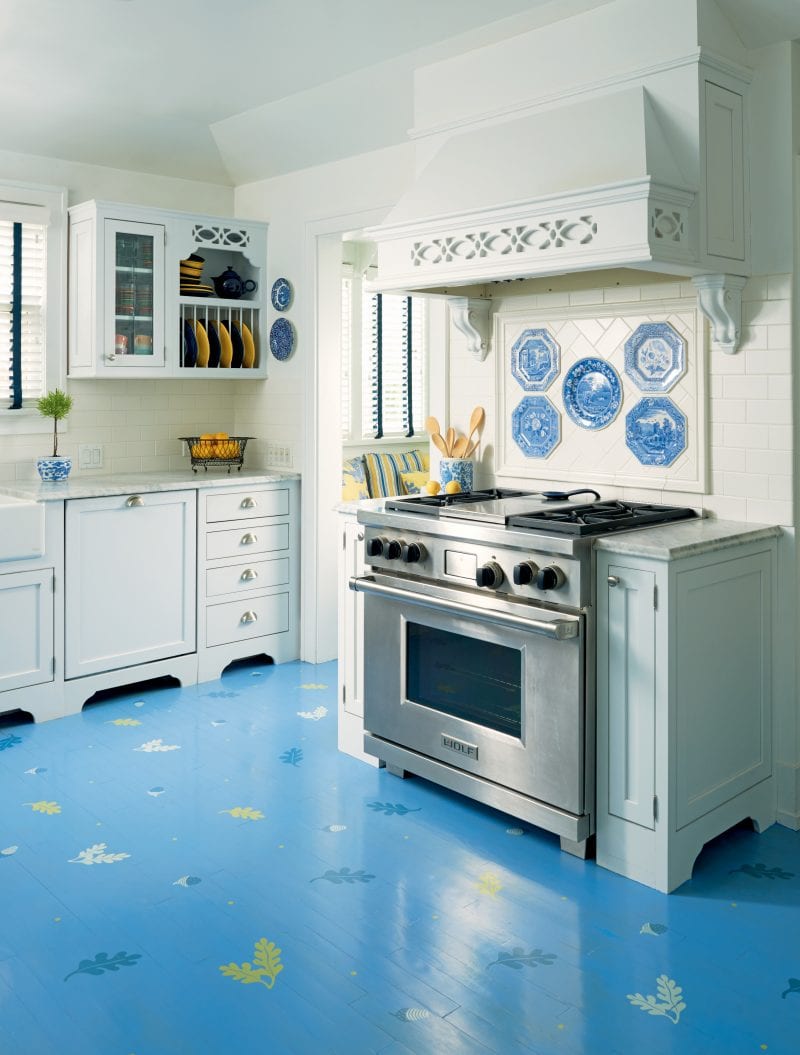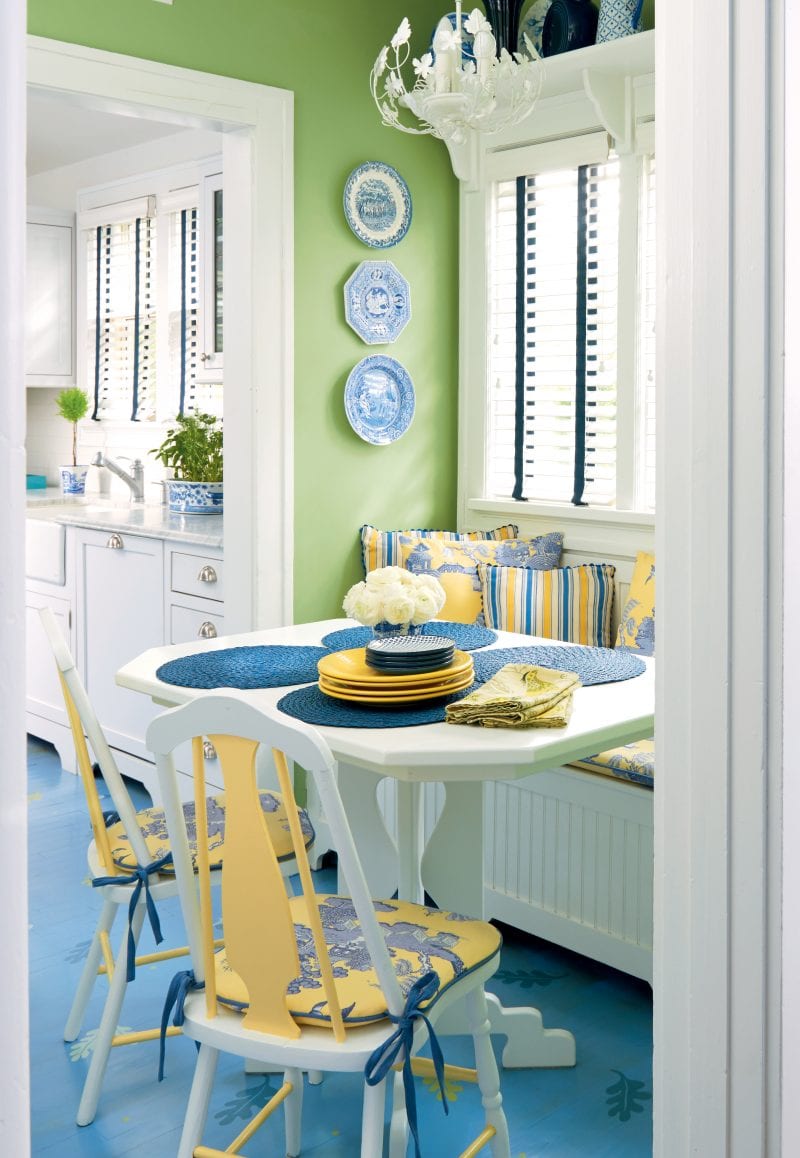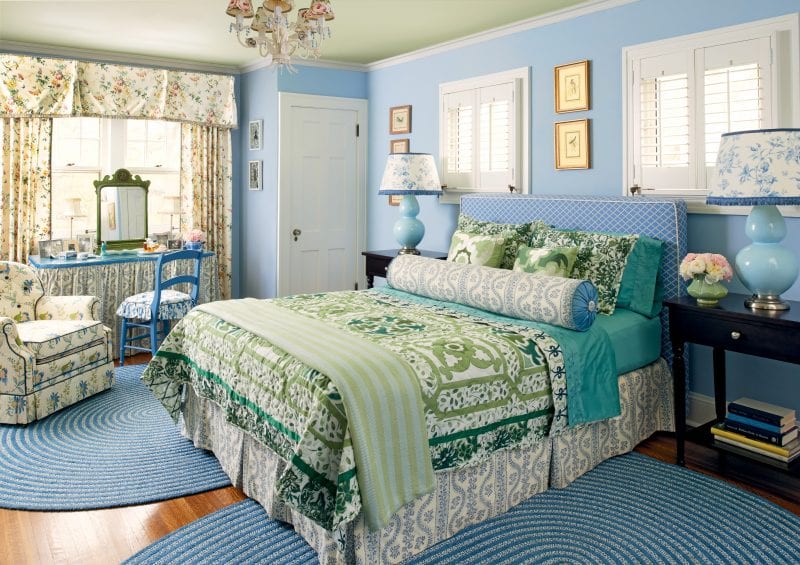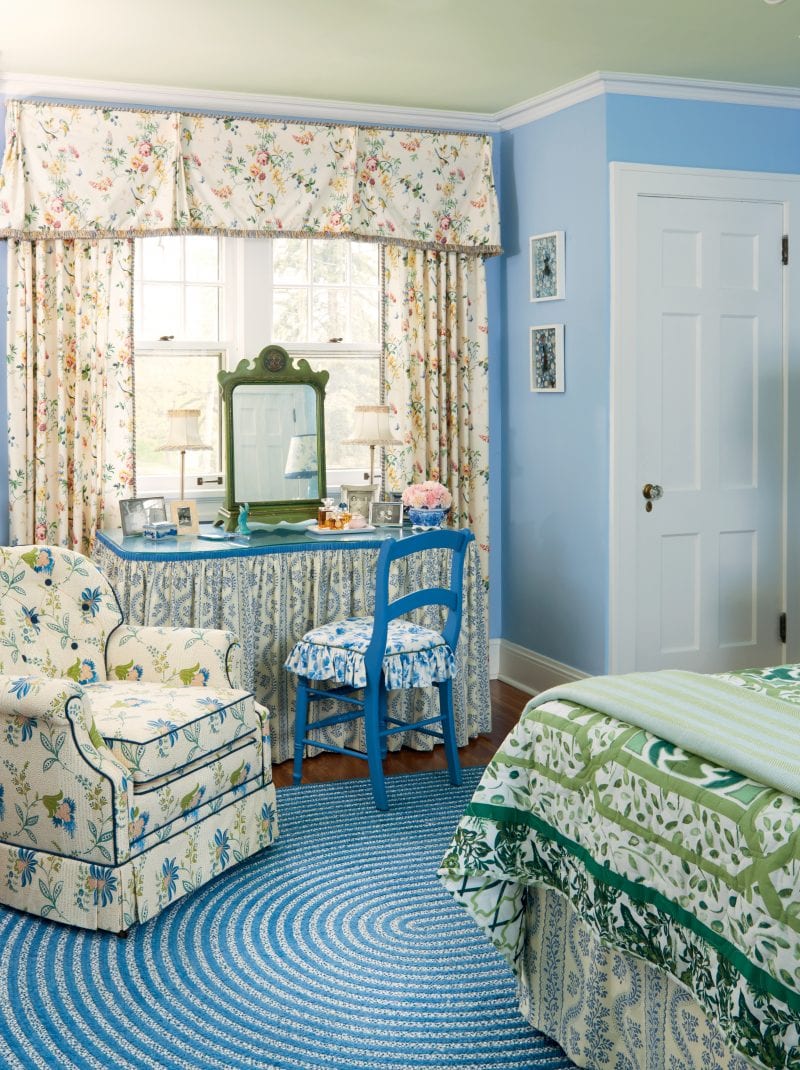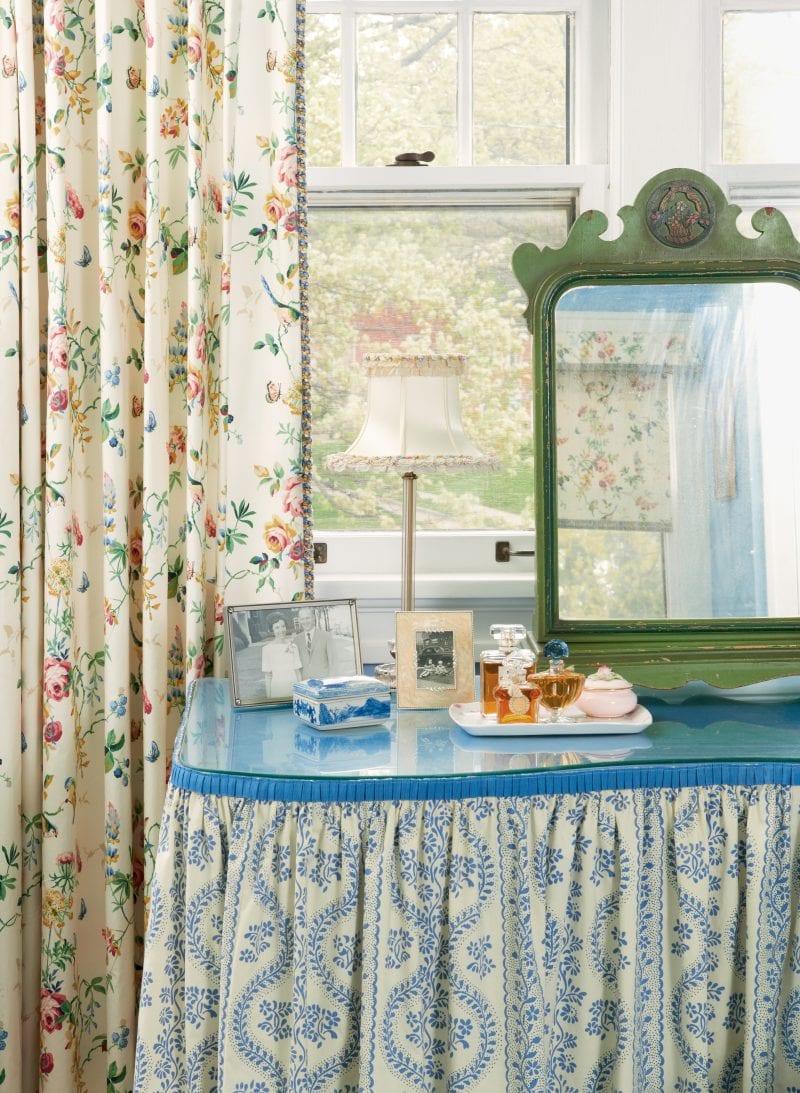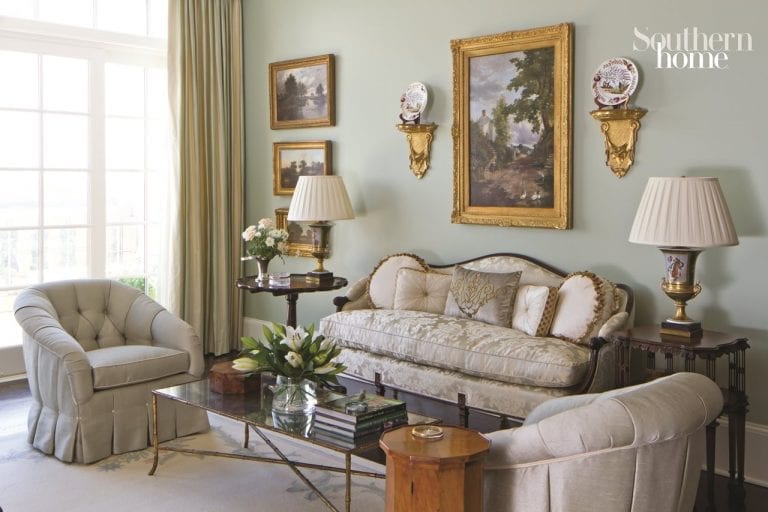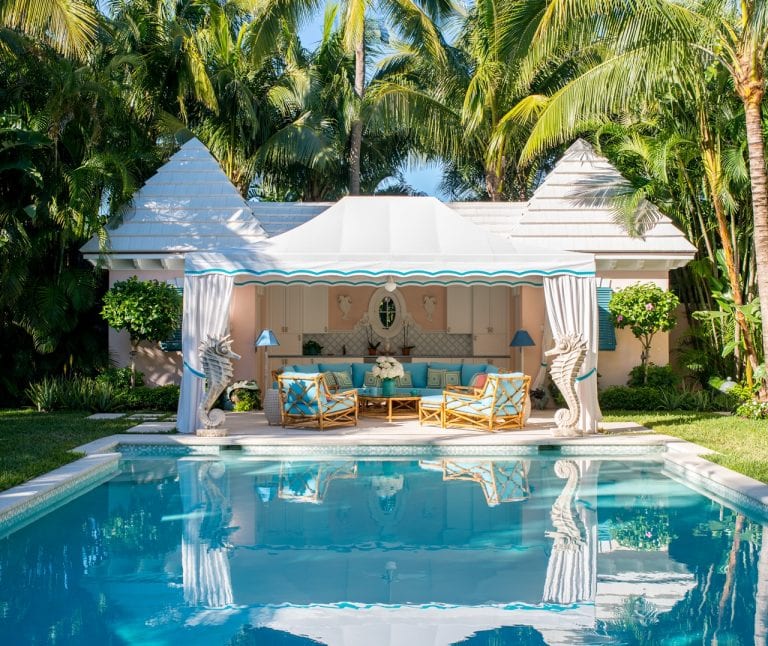


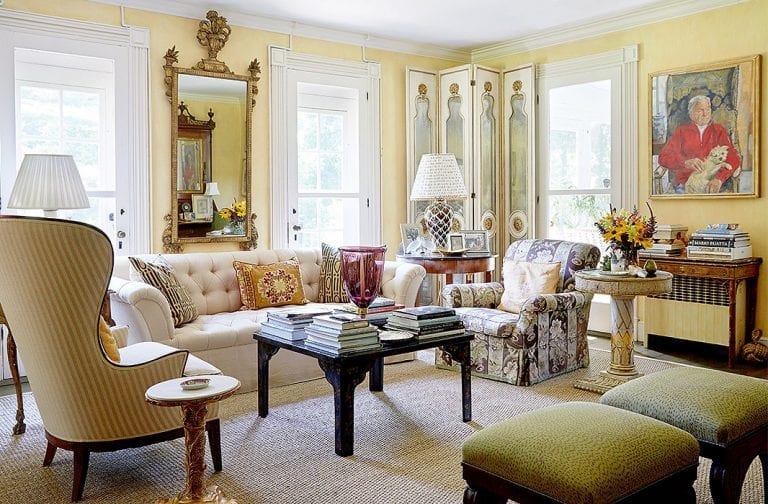
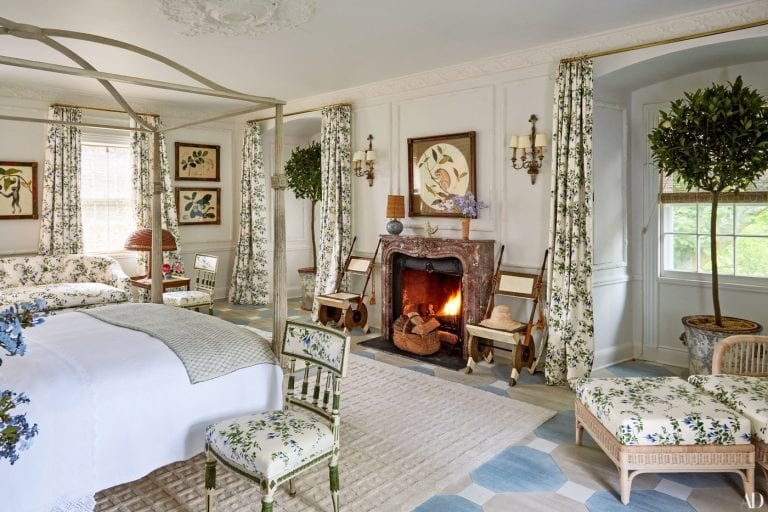

One of my favorite things about Instagram is discovering kindred spirits with similar design aesthetics. I recently “met” Lindsay, a fellow Texan who lives in Dallas with her husband and four children (three boys and a little princess) when her daughter’s Lilly Pulitzer themed bathroom was featured by The Beaufort Bonnet Company. Lindsay has no formal design training, but her grandmother was a decorator, s0 Lindsay was exposed to fine antiques and fabric stores from an early age. This sense of style was passed along to her mother, and now to Lindsay as well. Eager to see more, Lindsay has graciously agreed to take us on a tour of her elegant home while sharing her tips on how she also made it kid-friendly…
Q: How would you describe your style?
A:I would describe my style as formal French and traditional.
Q:Please tell me about your home (what year was it built, etc.) and your design process.
A:Our house was built in 2000. We bought it in 2013. When our third child was born in 2012, we were living in a small home, and busting at the seams. Originally, we were going to build a new house. We found and bought a pretty wooded lot with an old house, which we tore down. We spent a year drawing up architectural plans to build a formal French house. A few days before we broke ground, the neighbor, also new to the street, complained to us that there was a cabinet maker one block away making loud constant noise. It was highly likely the noise would be heard inside once the house was built. We abandoned ship, and we were disappointed.. I believe things always happen for a reason. We began to search for alternatives, whether it be another lot or another home. I found a house nearby for us to look at. I knew the second I stepped foot in this house, it was the one. Amazingly enough, the layout and style were very similar to our plans. We spent 4 months renovating before we moved in. The house had a lot of outdated dark wood, we painted it all a creamy white. We moved in February 2014, and have not stopped renovating since. My 2 year old daughter knows the painters by name. We are almost finished, hooray! None of the furniture from our old house would work well in the new. Basically, I was starting from scratch. I worked slowly, and took my time with each decision. For example, if we needed a light fixture, I would painstakingly scour the internet finding the perfect one. Since I took my time, I feel like I made less mistakes and really allowed myself to cultivate my style. I started with basic things such as a khaki linen sofa, and layered along the way. There was a long time we only had a few sofas, tables and chairs, and beds. This has definitely been a process. Our most recent projects have been the kids’ bathrooms. I gave each bathroom it’s own personality that tied into the room. I had fun picking out all of the details, especially the wallpapers. In my big boys’ bathroom I did a blue background Thibaut grasscloth, with herringbone wood tile floor. Their room has navy wallpaper with maps printed on it. In my 5 year old’s bathroom I had the cabinets lacquered the same blue as the wallpaper from his bedroom. In my 2 year old girl’s bathroom, I went crazy with pink Lilly Pulitzer for Lee Jofa wallpaper and fabric.
Q:When did you become interested in interior design, and where do you find inspiration?
A:My grandmother was a decorator. She loved beautiful antiques, fabrics, and rugs. I grew up visiting my grandparents in their gorgeous home filled with unbelievable collections. My parent’s house is very similar in style. I remember being dragged to antique malls and fabric stores from a young age, it was just part of life. It’s funny though, as a child my mom insisted on dressing me in traditional Southern smocked dresses, I hated it! Everyone else got to wear cool funky clothing. I would say I am never going to make my kids wear that type of clothing. As a teenager, I would also say I am never going to decorate my house like theirs, I wanted a modern home. Well, here I am now dressing my children traditionally, and decorating my home just like my grandparents and parents. I find inspiration in many places. I am inspired by the palaces of Europe. I get inspiration from books, magazines, Houzz, and Pinterest. I can get lost for hours on end perusing Pinterest.
Q:Who are your favorite interior designers (past and present)?
A:My favorite designer is Bunny Williams, I think she is a genius. It amazes me how things she did 10 years ago, are on trend now. She has a way of putting magnificent rooms together layer by layer. For formal French I like Betty Lou Phillips, and Charles Faudree.
Q:Do you have any professional interior design training or experience?
A:I do not have any professional interior design training, and the only experience I have is with my own home.
Q:What are the most important considerations when designing a home filled with young children?
A:First off, we are very laid back. We love to entertain family and friends, which means our house is always filled with kids. I know that it is a possibility with kids running around that things will get broken or stained. It happens. With that said, I picked stain resistant fabrics like Perennials. I did all of the sofas in slipcovers that can be washed. Also, Oriental rugs especially Heriz (my favorite) hide everything. We have a no ball throwing in the house rule, you can imagine with three sons how hard that one is. We tell our kids when they have their friends over, it is their job to make sure their friends respect our house. Their favorite in house game is hide and seek, we have some amazing hiding spots.
Q:Are there any treasures you enjoy collecting? Do you like hunting for vintage and antique pieces, or do you prefer new?
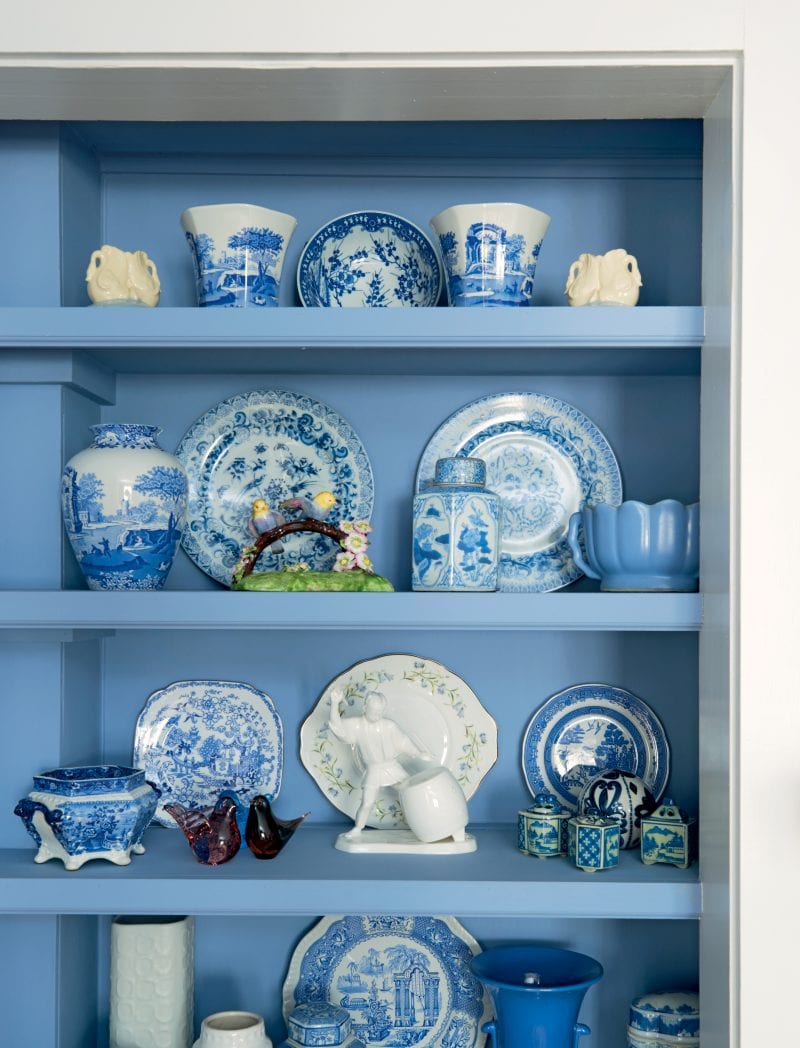
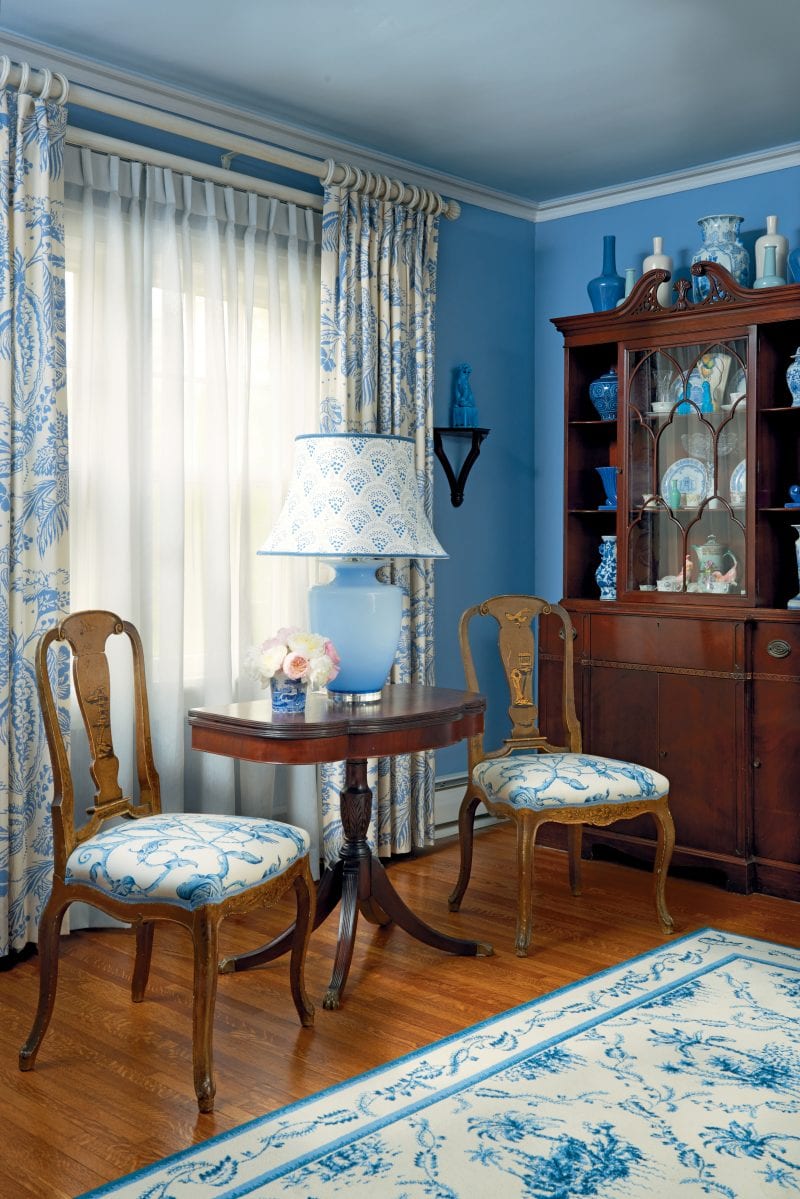
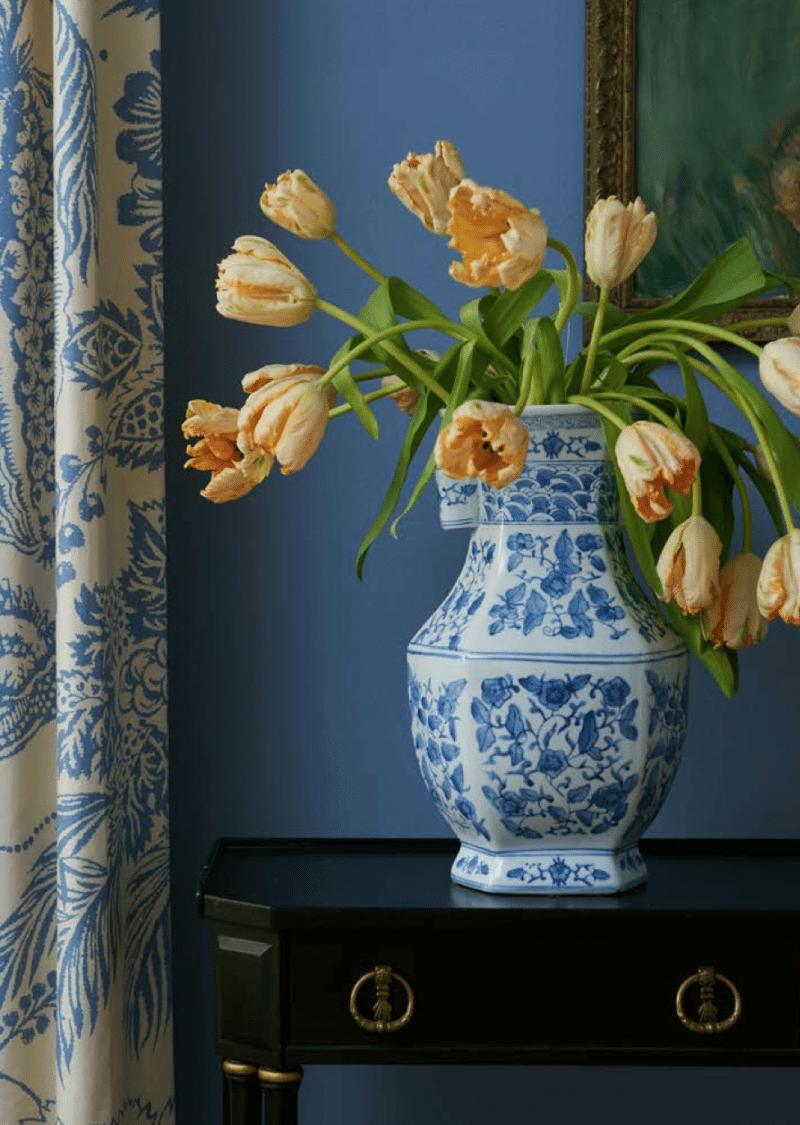
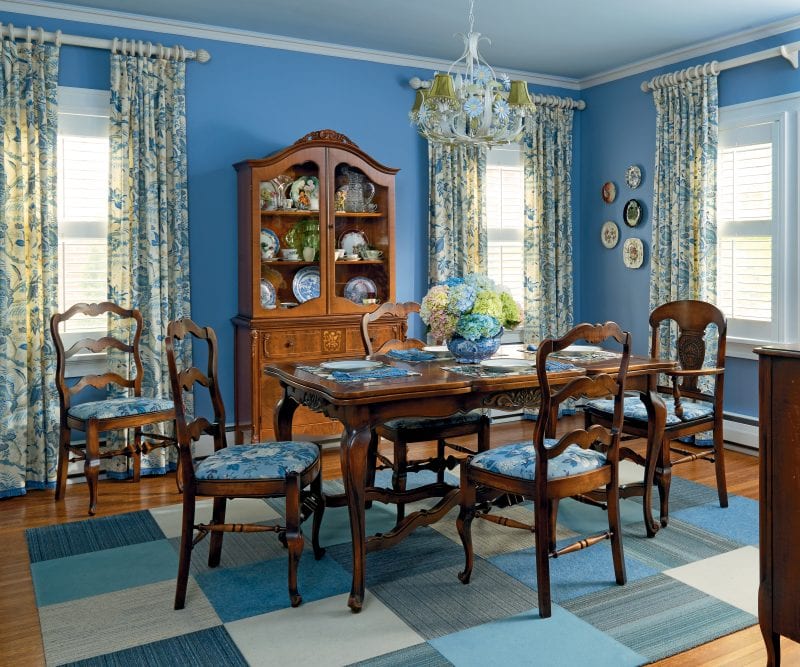
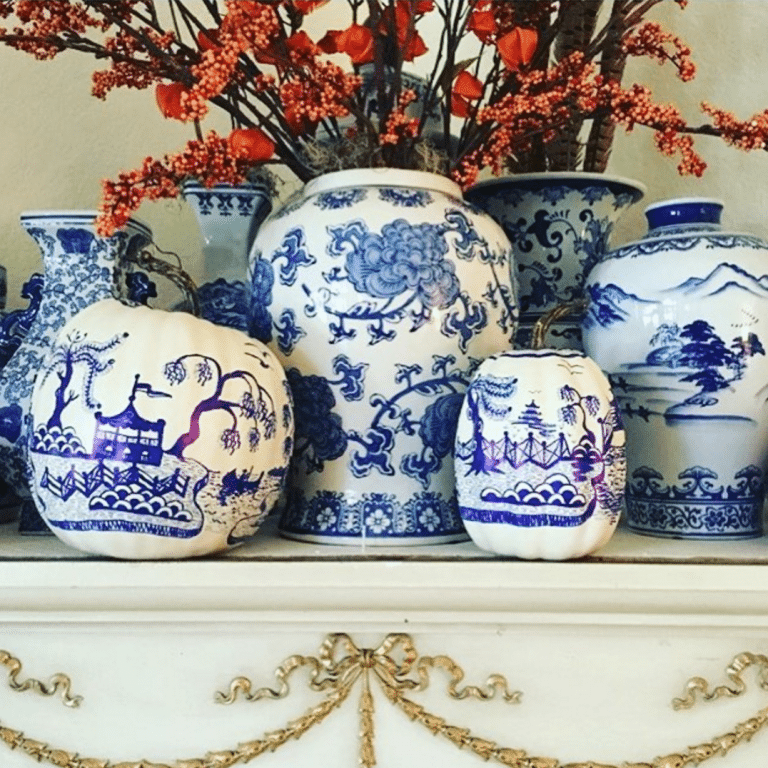
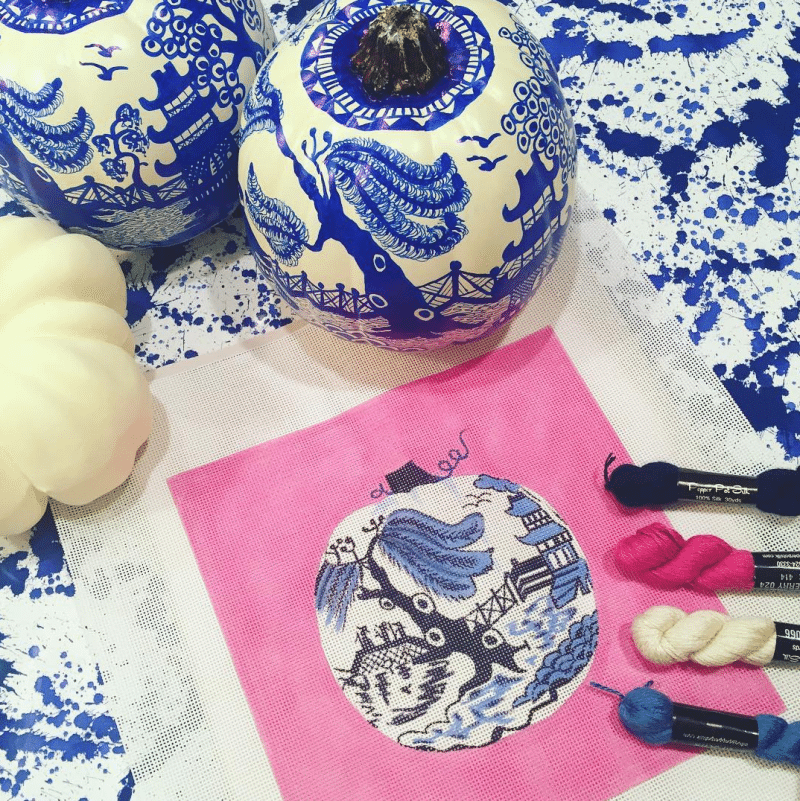
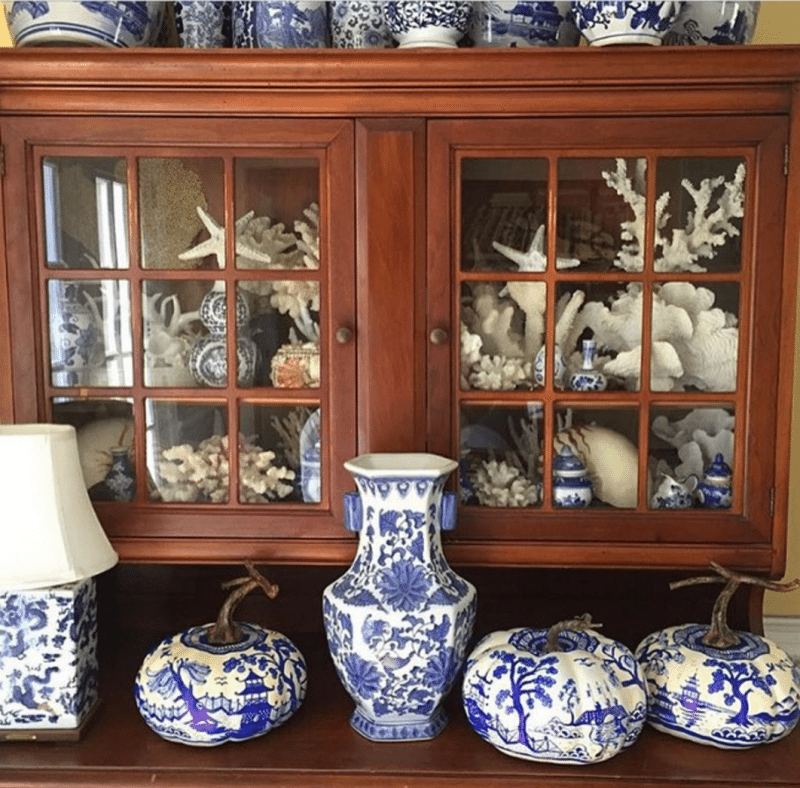
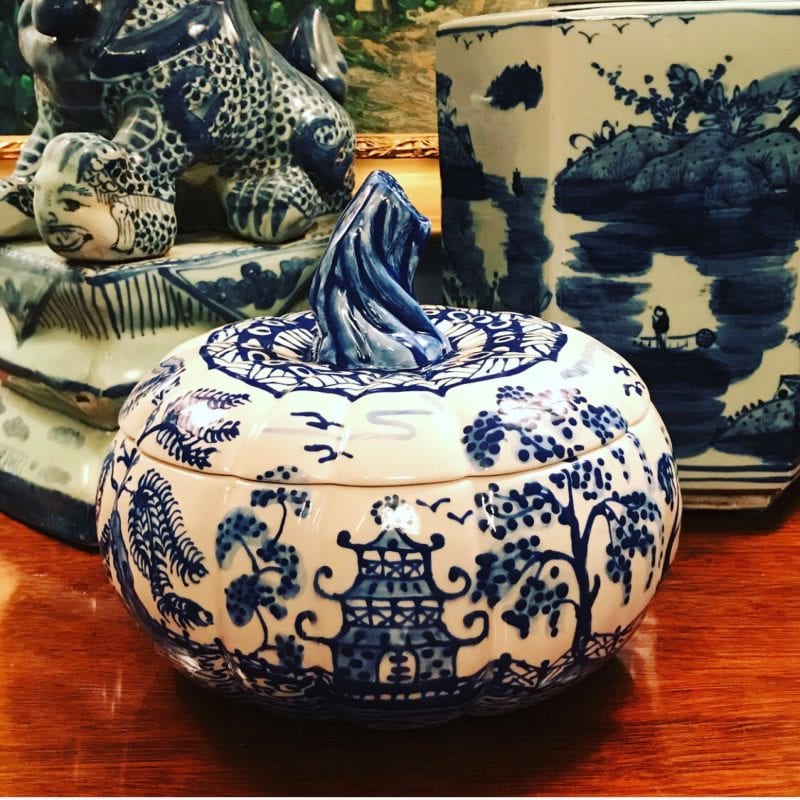
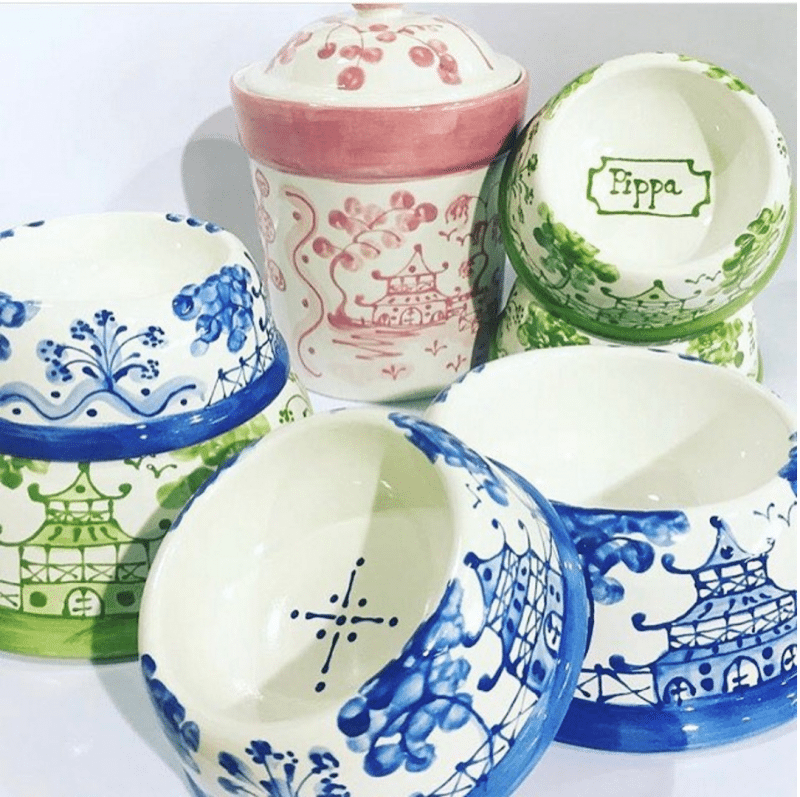
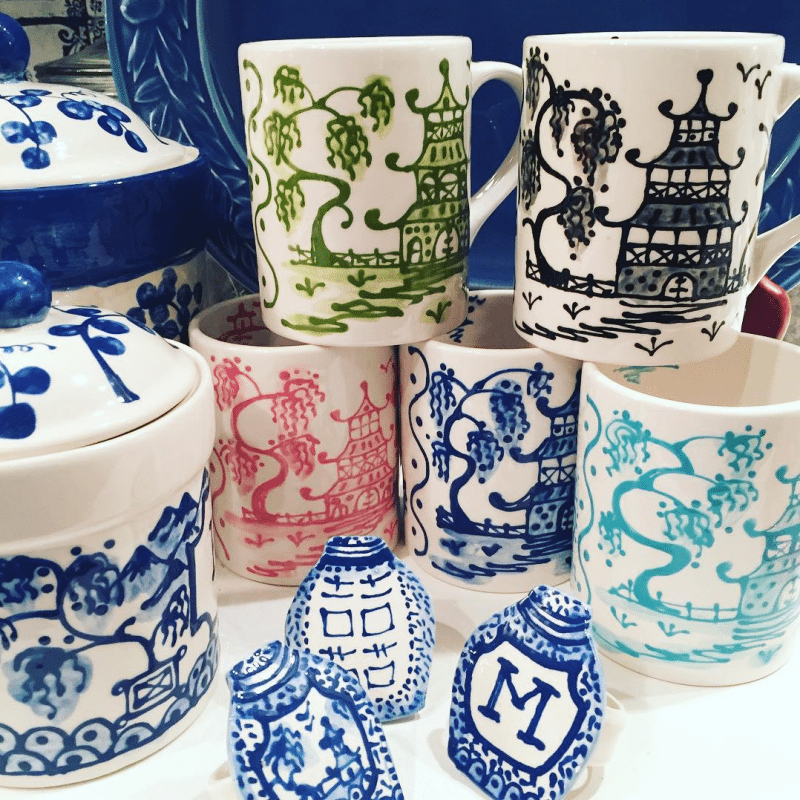
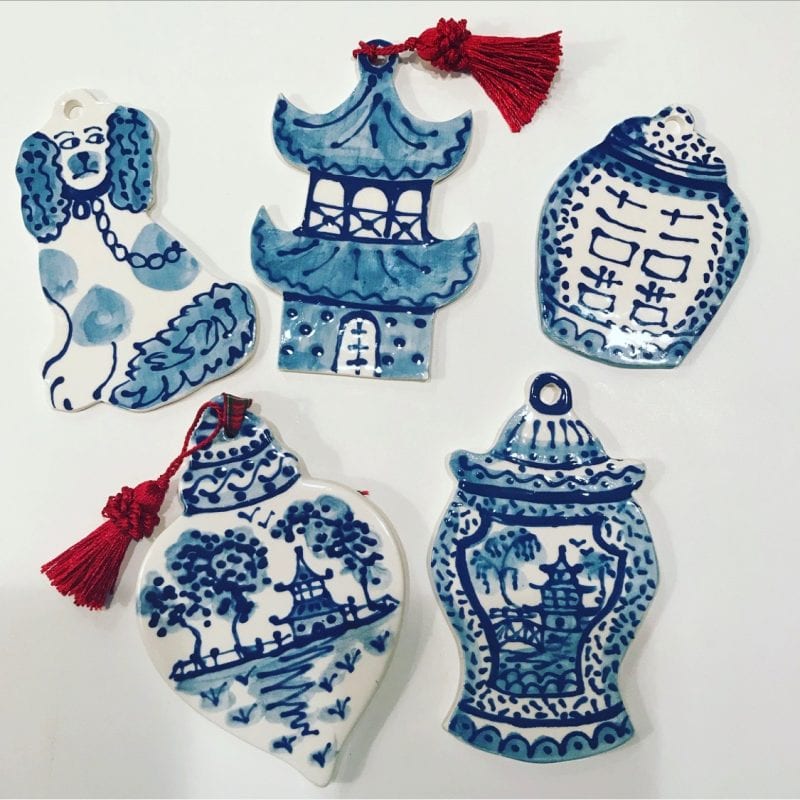
A:I frequent two nearby Antique malls. I collect Rose Medallion for my formal living room, Imari and Mason’s ironstone for the library, and Blue and White pottery for the kitchen, breakfast room, and den. I also collect Staffordshire and Majolica. Some of the furniture in my house is new reproductions of antiques. For tables, I chose many from Theodore Alexander, and Decorative Crafts. For mirrors and sconces I had luck with Friedman Brothers My rugs are a mix of new and antique. I find rugs lend a great deal of personality to each room.
Q:Do you have any additional projects in store for your home?
A:I do! A few months ago we bought a ranch about 40 minutes away. I have had the best time decorating it. The house is Mediterranean on the outside and Modern on the inside. Although this wouldn’t be my go to style, I am having fun playing off of the clean lines. I’ve incorporated traditional fabrics and wallpapers, think all things F Schumacher and some Brunschwig & Fils. I am using a lot of Bungalow 5 furniture. I am adding equestrian accents to give it a ranchy feel, and of course Chinoiserie everywhere (because that’s ranchy right?!)
Q:What do you enjoy doing in your free time?
A:In my free time I enjoy playing competitive tennis, I play on a team with a bunch of friends. I love shopping, I have a passion (obsession) for dressing myself and my family. I enjoy cooking, after all I am a professional pastry chef. I went to culinary school for 3 years. I read voraciously, I love a good fiction book. Lastly, I enjoy traveling, specifically to Europe or the beach.
Q:Anything else you would like to add?
A: Although it is nice having a beautiful home filled with beautiful things, the most important thing inside it is the family, and I never want to lose sight of that.
Thank you Lindsay, for inviting us into your gorgeous home! You are such an inspiration!! For an additional glimpse into Lindsay’s beautiful world, please follow her on Instagram.
Designer James Farmer‘s elegant new book, “A Place to Call Home – Timeless Southern Charm” will be released for sale this month, and this is one you will not want to miss. An unabashedly Southern gentleman, Farmer’s interiors respect Southern heritage while freshening the look for today. A Place to Call Home tours 11 beautiful homes in the deep South including a home with antebellum roots, a Georgian-style house in the suburbs, a country farmhouse, a Sea Island retreat, and Farmer’s own family home. Woven alongside beautiful photography are personal stories Farmer shares about living in the South, the people in his life, and how he fell in love with a career of making houses into homes. Photography by Emily Followill for Gibbs Smith.
A Place to Call Home is a beautiful book to inspire Southern style at home―infusing the new with antique, vintage, and heirloom pieces.
For years, American expatriates Shauna Varvel and her husband enjoyed spending summers with their five children in Provence. In 2014, kismet led them to rent the home that is now Le Mas des Poiriers, an 18th century farm house nestled among 65 secluded acres including working pear orchards. The family fell in love, and a year later when the property became available for sale, they decided to buy it. Le Mas des Poiriers underwent extensive renovation by the esteemed Alexandre Lafourcade. Landscape architect Dominique Lafourcade transformed the gardens, and Susan Bednar Long redesigned the interiors using Pierre Frey fabrics exclusively. Every inch is true to the spirit of Provence.
Le Mas des Poiriers is available for rent, and I am fantasizing about a dream vacation in Provence! In the meantime, I am delighted to welcome Shauna Varvel to The Glam Pad today for a virtual holiday…
Q: How did Le Mas des Poiriers receive its name, and what is the English translation?
A: Our farm, Le Mas des Poiriers, produces 60 tonnes of pears annually and the house sits adjacent to the pear orchard. The actual and original name of the house is Grange Neuve, which we use, but we have named the farm Le Mas des Poiriers, which translates as “The Pear Trees Farm House.”
Q: In what year was Le Mas des Poiriers built, and what is its history?
A: The house was built over 200 years ago as a farm house, or a “Mas.” The Rhone River divides near Avignon and the Palace of the Popes and the farm sits between the two arms of the Rhone, on an island. Thus the property’s land is very fertile and green, which is unusual in this dry and rocky region. The farm was formerly in a flood plan and had a high platform near the barn that served as a place to put the animals during during a flood.
Q: What inspired you to purchase this beautiful property?
A: Provence has been a passion of mine for many years. When my five children were young, we would rent a house for a month or so in the summertime, spending our mornings at the markets or visiting ancient Roman ruins, our afternoons by the pool, and our evenings making dinner together and eating al fresco in the garden to the tune of cicadas. We created beautiful memories as the children ran around in the Provencal sun without the distractions of everyday life, picking grapes and pears and enjoying the beauty and serenity of the region. In the summer of 2014, we rented the home that is now Le Mas des Poiriers and fell in love with it for its uniquely large structure and distinct location, being within minutes from the charming city of Avignon and yet in a secluded world of its own on a fertile island within the Rhone River. We were thrilled a year later to discover that the property had been listed for sale. We knew that we loved having 10,000 square feet in one building to fit our large family (many properties in Provence connect small buildings together to make one), the high volume in the ceilings and the flat and green land surrounding the property. We also knew that it would be a lot of work but we felt that in the end, the effort and investment would pay off in a way that it couldn’t in other properties.
Q: Please tell me about the architectural, interior, and landscaping renovations you have overseen.
A: We hired the Alexandre Lafourcade architect team for the renovation. They are the clear specialists in this region for these kinds of old houses. Through their vision we were able to re-organize the exterior, adding a new front door in a new location, tearing out ceilings and staircases to make a new beautiful front entry, add a new master bedroom, family bedroom, living room and mud room in a space that had formerly been a barn, with a dirt floor. We tore out floors, walls, all bathrooms, added antique fireplaces, new floors throughout, etc. We used finishings that would have been used traditionally in the house, like Dordogne stone floors, on the main level, reclaimed antique terracotta floors on the upper level and traditional marble cut in a Provencal style in the bathrooms. We completely changed the landscape working with the famed Provencal landscape designer, Dominique Lafourcade. We moved the swimming pool from the south side of the house to the west, the kitchen side of the house which made more sense to us. We added a tennis court adjacent to the swimming pool and Dominique designed a charming tennis court house on the east side of the court, painted a beautiful French blue. The property boasts 75 200-year-old plane trees in three allées, which were cleaned and pruned to highlight their beauty. Additionally, we added very tall cypresses to form a cypress allée coming off the center axis of the house. We added a wisteria covered arched walkway to the pool and also a beautiful rose covered archway off of the living room. The tennis court is surrounded by old olive trees, lavender and plants that would be found in the Luberon valley, giving it a distinct feeling that is different from the rest of the property. There was an old decrepit barn on the property that we renovated to house two staff apartments with a two-bedroom apartment upstairs and a one-bedroom apartment downstairs. On the east side, there is a view of Mount Ventoux and we have a large room that can be used as a rec room or a staff room.
Q: What was your vision for the beautiful interiors, and were you able to work with antiques original to the home? How did you decide to use Pierre Frey fabrics exclusively throughout?
A: The house is very large and could have been decorated and finished to feel more like a Bastide or a Villa, but I felt strongly that it should maintain the feeling of the country farmhouse that it is. I absolutely love and was inspired by the La Mirande Hotel that is just across the river from us. The La Mirande is a city hotel and is very elegant but we took inspiration from their fabrics, bathrooms and from their Chef’s Table kitchen, in the basement of the hotel. In fact, our kitchen, was built by the son of the gentleman who built the Chef’s Table kitchen years ago. We did inherit some antiques with the house and have used them in a few places. We inherited some lovely hunting dog paintings that feature in the entry and living room and two small desks that are in the living room. Additionally, I travelled between Paris, shopping on the left bank and at the weekend market, Isle sur la Sorgue in Provence and London for the Decorative Antique Fair, every few months collecting antiques and art. It took the full two years to find all of the pieces needed to fill the house.
Regarding Pierre Frey, I have long loved their traditional French country fabrics and was thrilled to be able to integrate them here. I worked with a decorator, Susan Bednar Long, with whom I have had a long professional relationship. We worked together on this project and sat in the Pierre Frey showroom in Paris for two days straight pulling fabrics and creating fabric schemes for each room. The manager of the Paris showroom, Eleonore, came to the house several times during the project and recommended the seamstress and upholsterer that Pierre Frey uses in Paris.
Q:For a guest staying at Le Mas des Poiriers, what does a typical itinerary look like for a long weekend visit? And for a week or more? What activities do you recommend?
A: We rent the entire house for approximately 4 – 5 weeks a year on a weekly basis. In a week, you could cover many of the famous Provencal villages in the area and visit some of the most popular markets. There are a myriad of sites and markets to visit in Provence. We recommend that you take it slowly and balance days out with days lounging by the pool or playing tennis, touring the gardens, sunflower fields or pear orchard at Le Mas des Poiriers attended by our thoughtful and professional staff. Gordes is a favorite among most visitors along with the other hilltop villages in the Luberon Valley such as Bonnieux, Lacoste and Menerbes. When visiting Gordes do not miss the lovely Abbey Senanque with its lavender fields, just beyond Gordes in a beautiful canyon. Avignon is just ten minutes away and is home to the Palace of the Popes, one of the largest and most important Medieval Gothic buildings in Europe, and a UNESCO Heritage Site. Pont du Gard, the highest and one of the best preserved Roman Aqueduct and another UNESCO Heritage Site, is just 30 minutes away to the west. St Remy and Eygalières are very popular market towns with markets Wednesday and Friday mornings. Arles boasts a beautiful Roman Coliseum that rivals the famous coliseum in Rome and Nimes is home of the beautiful Roman Maison Carree.
Lavender fields at Abbey Senanque
Q:Your culinary team sounds amazing, please tell me about dining at Le Mas des Poiriers.
A: Our culinary team are state of the art with experience from New York’s Park Avenue to fine French kitchens. They are on-hand to create a personalized menu for each meal during your stay, moving your dining experience from our patio to the plane tree allée, the cypress allée or by the pool for a beautiful and varied experience at each meal.
Q:How many guests can Le Mas des Poiriers accommodate at one time? I would imagine this would be an ideal venue for a destination wedding!
A: We have nine double bedrooms and have a maximum sleeping capacity of 18 guests. Le Mas des Poiriers is a perfect wedding venue and we collaborate with the incredible talented team of Matthew Robbins Design to coordinate events.
Thank you, Shauna, for sharing your enchanted home with us today! Le Mas des Poiriers is now at the top of my bucket list.
With seven bedrooms in the main house and two additional bedrooms in the guest house, Le Mas des Poiriers offers the utmost in seclusion and luxury. The property boasts a tennis court and swimming pool, and it is professionally staffed with a culinary team of two chefs and two waiters, as well as full-time housekeeping. Within easy reach of Avignon, Chateauneuf-du-Pape, Gordes, St. Remy, and Aix-en Provence, Le Mas des Poiriers is ideally situated to access all that the region has to offer, should you decide to spend a day away from the peaceful property.
This month, D. Porthault will release its long-awaited first book, D. Porthault: The Art of Luxury Linens… and it is a veritable feast for the eyes. Founded in Paris in 1920, Porthault has developed a loyal following that has included royalty and celebrities such as Charles de Gaulle, Sir Winston Churchill, President and Mrs. John F. Kennedy, Lee Radziwill, the Duke and Duchess of Windsor, Grace Kelly, Coco Chanel, Audrey Hepburn, and Elizabeth Taylor. The Art of Luxury Linens takes us inside some of the most beautiful homes in America, revealing why D. Porthault has been the favored French luxury brand for linens and other fabrics for nearly one hundred years. Below are a few of my favorite images from this incredibly lovely book…
Photographs by Erik Kvalsvik from D. Porthault: The Art of Luxury Linensby Brian D. Coleman, reprinted by permission of Gibbs Smith.
A heavenly mix of D. Porthault linens, Dodie Thayer cabbage ware, and William Yeoward. Design by Mario Buatta.Designer Laura Lobdell created this special Porthault palace inspired by Marie Antoinette’s Petit Trianon at Versailles.A charming and elegant bedroom by Mario Buatta.A beautiful breakfast room and tablescape by Leta Austin Foster. Leta also sells D. Portault in her Palm Beach boutique.Aerin Lauder’s lovely Manhattan bathroom
With cheery bedrooms, sweetly decorated nurseries, beautiful bathrooms, and elegant tablescapes, the entire book is full of scrumptious eye candy… You will want to order your copy today! D. Porthault: The Art of Luxury Linens is available through Gibbs Smith and Amazon.
Style icon and Bravo star Patricia Altschul knows a thing or two about interior design… She has worked with the legendary Mario Buatta in designing four homes, and her professional background as a rare art expert and dealer has taken her everywhere from Buckingham Palace and Versailles to the White House. In her book, Southern Charm, Patricia quoted Mario on his mantra that decorating cannot be treated as fashion. “A great room is an investment of time and money, and if you do it correctly the first time, chances are you will never get tired of it,” he said. And Patricia agrees.
Today, I am thrilled to welcome Patricia to The Glam Pad, as she shares her insider tips on how to create a beautiful and classic home and previously unpublished pictures of her collections. Below are highlights from my interview with Patricia…
TGP: Of all the beautiful homes I have written about since beginning my blog five years ago, yours is my all-time favorite. How do you go about creating a timeless home, one that you will always love and is worth the investment?
PA: In terms of investment, first of all you have to decide what you need. There are three things that I consider “need”…
Comfort, which a lot of people overlook. They simply go for appearance. Comfort is what really makes your house a home. Then the aesthetics. Let’s start with the living room, for example. The first thing Mario and I do is decide on color. And that dictates almost everything else. So let’s take my living room, which is apple green. He added and subtracted and customized it, but you can actually buy apple green at Benjamin Moore. He doesn’t do just a little swath… He does a huge swath of color and lets it dry and he looks at it in the different times of the day. Most people don’t do that, and you can paint a room and then realize the next day you cannot live with it. You want a color you can live with that looks good night and day. That’s your backdrop.
2. And then the next thing that I think is an investment piece is a good sofa. It should, like most upholstered furniture, have down. Most of mine is down filled except for some side chairs. So let’s say you start with the sofa… You want as good of quality as you can get. And Mario always picks a cream colored sofa as the focus.
3. Then you get a large and functional coffee table – another investment piece – not a flimsy glass coffee table as your primary coffee table. You want something where you can put heavy books, hurricane candles… And then you have a pair of club chairs. We usually buy them in muslin and then pick out fabric. Of course, I love chintz and Mario loves chintz. And I would say there are so many really pretty florals that you can choose from. I just cannot imagine not loving chintz. Whatever pattern you choose for your chairs can also be used for the curtains.
PA:That to me is your core. You also need floor lamps, and you need small tables to put drinks on. Mario usually has a skirted round table at the end of the sofa on one end, or you can have a pair. And then to add seating, he has two armchairs – usually antique – that you can rearrange. So that’s kind of a basic treatment. And then what you do is add mirrors – I like gold mirrors because it adds a little gilt – crystal sconces on the wall are always pretty, and then paintings or watercolors, depending on your taste. A covered upholstered ottoman is always nice. These are things that are kind of universal, and then you extend the same discernment to every room. Like in a bedroom, the first thing you do is get a really good quality bed and pillows. And of course you start with the color – I always start with blue because blue is serenity. I think it is nice to have a chaise, and again I always have a white sofa and armchairs, and they are all covered in the very same fabric.
PA:For a neophyte doing this on their own, I suggest you buy Mario’s book and copy his designs. Copy his curtains, copy as much as you can, and also pay attention to scale. If you look at enough pictures, you can get an idea as to proportion and scale. That is the hardest thing to get.
PA:When I was in school at GW (George Washington University), I got a Smithsonian scholarship. I worked in the history and technology building where I would help hang paintings and objects. I know there are rules about how far from the floor things should be and the ceiling, but almost all of the curators did it by eye. They never measured. So having a good eye is important and you can train yourself to have a good eye. You can read trade magazines, you can go to designer homes, and read books and monographs on decorators who have a style you like.
Patricia’s son Whitney Sudler-Smith via Cote de Texas
PA: Once you get these core pieces in place you can let the rest evolve organically. It depends on the individual and how much they can afford to spend in each room, but I think houses always evolve. Even if you work with a decorator, it is done in stages. It would be nice to walk in and have one whole room done with everything, but it doesn’t work that way. It just doesn’t happen over night. And then you add things as the years go by and replace others.
Even Patricia’s home took time to evolve… Here is her living room prior to curtain installation, via a Bravo home tour.
TGP: How did you go about selecting the gorgeous artwork for your own home, and can you tell me more about your extensive collection?
PA: I spent many years advising clients and museums about art acquisitions. When I was a private dealer, I would have paintings in my home that I sold, and I would display them as if it were a home environment, not as a gallery. I had a lot of wall space. This was in Georgetown, and I had six floors to use. It was a large town house, and it was privately owned, so it was a conflict of interest for me to collect paintings. But I could actually live with great paintings that would ordinarily have been difficulty to collect personally… I had Monets and Renoirs, John Singer Sargents, and so forth. I did have small collections of things and I had things I had inherited that I kept in the private wing of my house.
A 19th century dog painting by Rose Bonheur from Patricia’s personal collection.Patricia loves British sporting art. This piece is by Thomas Blinks from her personal collection.
PA: I did buy paintings for Whitney… some large paintings that he has in California and Andy Warhol silkscreens (he has about four Warhols) and other contemporary artists… he loves them. And I bought him Ansel Adams photographs. When I married my husband, he was a major art collector – always listed among the top 10 art collectors at that time… It was fantastic because I felt like I was living in a museum. He had all of my favorite artists. I was more of an Americanist but he had post-impressionist paintings, which I had never really studied to any great extent… I learned so much during the time that we were married. He was on the board of all the major museums in New York. In Paris he had paintings exhibited at the Louvre, and actually all over the world…Whenever he had a painting in a museum in Tokyo or in Milan, we always would go for the opening. I learned so much at that time, it was an incredible experience. We were always going to museums, galleries, and auctions. It would range from garage sales to Grovener House and everything in between. We were busy. We were on the go all the time, and it was always a learning experience. When he died, he left me some major post-impressionist French paintings. We collected needlework together. I loved animals and dogs, and so I have quite a few of those sprinkled throughout the house. I like sporting art. To backtrack, I did buy myself sporting art years ago because my clients didn’t collect that. And I did have a few things like dog paintings and so forth that were not considered major art investments or acquisitions.
The framed needlepoint dog on bottom once belonged in the Kennedy White House.Queen Victoria’s Dogs and Parrot by Sir Edwin Landseer from Patricia’s collection.
PA: When I married Arthur, he had 700 paintings. One bedroom was nothing but racks for storage of pictures. One would go out on exhibit and another one go into the storage room. When we married, I had all these things that he thought were rather funny and laughable… All my dogs paintings, needlework, my silhouettes. So he said “I think we should have all of these things in the country house,” basically where no one else could see them. And he didn’t like contemporary art. So that’s when Whitney got everything, and from contemporary, I mean from the 1960s – on. So now I have Arthur’s important pictures mixed in with my dog paintings. (I think Mario softened him up about the dog paintings so he was a little more tolerant of my more eccentric collections.) But we both loved porcelain and silver, so we were busy collecting all of the above.
An actual silhouette of George Washington, one of the few portraits for which he posed.An antique needlepoint tigerPatricia’s collection of antique pugs
TGP: What advice would you give to someone on a limited budget who wishes to acquire fine art, whether antique or contemporary? Where can you save, and which pieces are worth an investment?
PA: If you are going to buy art, buy it from a reputable auction house. Study monographs on the artist… First of all I would go to museums and auction houses just to educate yourself. And when you decide what kind of art you like – because it should have a focus – then I would buy it from a reputable auction house because they have experts who are connoisseurs and can tell you that something is correct. That isn’t to say that they haven’t made mistakes, but very few.
A sterling silver tea set Patricia acquired from Brunk Auctions
PA: Instead of galleries, it is better to decide what school of art you like, find out which auction houses offer that, and I would subscribe to artnet. It tells you the prices of what every painting has realized over the last 15-20 years, and they have pictures. A lot of times, pieces come back up for auction, but even so you can get an idea for the range and quality. I would rather have one good painting in the living room and then fill in the other spaces with beautiful mirrors, sconces, and porcelain, rather than have – say four bad paintings – or rather one good one and four bad ones… It’s hard for people who haven’t studied – and really spent a lifetime studying – to go out and buy art. It’s daunting. With an auction house, you can always call up the person whose specialty is whatever it is you are trying to buy, and ask them questions about it… I always get a condition report. For buying art, Sotheby’s, Christie’s, and Bonhams – those are the three big ones – but if you go to some of the smaller auction houses, I buy bargains at Stair, Brunk, Doyle, Neal, Swann, Charleton Hall. You can look at catalogues online – you don’t have to buy the catalogues. Live Auctioneers (online) has all the small auction houses! I think the first tenet of buying art is that you should buy what you love… that is the most important thing… you want it to give you pleasure. Beauty is enhancing to your life, and every time you look at it you want to just be thrilled that you got it. And it does not necessarily have to be expensive. Sometimes you enjoy the bargains more because you got them at such a good price.
You may recall seeing Patricia bid on this antique clock during Season 4 of Southern Charm.
Patricia loves collecting Antique French clocks. Here is a rare 19th Century French Empire mantle clock from her collection.A few of Patricia’s antique dogs on display in her guest room.
TGP: Mario Buatta is one of the greatest interior designers in the world. Not only is his talent legendary, but he is also known for his delightful sense of humor. Can you share one of your favorite stories about working with Mario?
PA: After Arthur died, Mario was taking me to the Met Ball, and I get into the car and he has on glasses that are 40 times larger than any normal person would wear. They were outrageous! He was always doing things like that. And he had a roach named Harold. It was rubber, and we would go to restaurants and he would put it on the counter. We went to a Southern restaurant known for its fried chicken, and the owner came over and said to Mario, “You must be a Yankee, because no Southerner eats fried chicken with a knife and fork.” So Mario decided that he would get back at her, and took Harold out – because Harold is always with him – and he put him under a plate. Then he called her over and said, “Do you usually have these in your restaurant?” And she said, “Oh yes, I just pick them up and through them out the front door.” Then someone gave Mario a Harold that was motorized. One time we went to a Mexican restaurant in New York, and Mario wanted to sit at the counter so he could wind up Harold and have him go down the length of the counter in front of all the patrons. The waiter thought it was funny, but the patrons didn’t! One Christmas he gave me earrings with plastic cockroaches.
Mario Buatta, image courtesy of Patricia Altschul
TGP: You and Arthur also shared a passion for porcelain vegetables and antique silver. How did your love of antiques help bring you together?
PA: Well he had more of the blind earl flat leaves, and I had more of the vegetables, but they were all Chelsea porcelain. I liked so much of his art, but he liked very esoteric pictures. But we both liked and had the same kind of silver and Chelsea porcelain. Not too many people would have that much of a coincidence in terms of the things they owned. It is fun for couples to have something that they enjoy collecting because it can take you everywhere and it should be something that you can look for in any country. We used to get the Maine Antique Digest, and it would tell all of the antique shows, auctions, whatever. We had a house in Connecticut, so we used to drive to antique shows. Some of them were great, and some of them were terrible, but it was kind of the fun of the hunt. You never knew when you were going to discover a treasure.
Patricia’s collection of Chelsea porcelain along with other 18th century piecesA Buccellati shell…and a Van Day Truex silver gourdBeautiful antique Chelsea porcelain vegetables and Wedgwood shells. The purple cabbage is 20th century.A collection of antique blue and white urns
TGP: Your home is an excellent example of how interior design and entertaining go hand-in-hand. Every piece of your furniture and each room is conducive to hospitality. What are the key elements to consider when designing a home that will make guests feel comfortable and welcome?
PA: I think flow is important… where you put pieces of furniture and where you don’t… And it has to make sense. But also, you want areas where people can congregate, and you want lightweight arm chairs that you can move around. If you have a large enough space, you want different seating areas. And you want things like ottomans and armchairs that you can move. I have two stools in my living room – a round one that is right next to the coffee table and square one that’s behind the sofa table that separates the one drawing room from the other. Many times, I have pulled armchairs, stools, and barrel chairs…. You want to have the possibility of moving things around so you can accommodate more people. Seating arrangements are important, and you should have pieces that you can move around, but I think comfort is the most important aspect of decorating. And I never get tired of these things… I’m not one of these women who always changes everything. I will never redo my home.
TGP: And that goes back to timelessness… When you follow trends, you have to constantly redo your home because it looks dated by the time you finish getting it done. But if you follow the classic, traditional approach, then it does last forever, and that is why I love your house and why I love Mario.
PA: People still say the blue room Mario did 20 or 30 years ago is one of the best rooms ever decorated, and then there is the yellow room that Nancy Lancaster did. They are iconic and beautiful. Comfortable and beautiful.
With Carson Kressley filming Southern CharmImage via Patricia’s InstagramMario Buatta’s 1984 Kips Bay Decorator Show House bedroom “that shook the world,” according to Architectural Digest.
TGP: Thank you so much, Patricia, for sharing this invaluable information, and for giving us a never-before-seen glimpse into your fabulous collections! I already own Mario’s book, which is at the very top of my list of favorites, and I couldn’t agree more with Pat’s advice to copy, copy copy!
For additional inspiration from Patricia Altschul, you simply must read her book The Art of Southern Charm. You will also want to follow her on Instagram along with @welovepataltschul, her official fan club, and don’t forget to check out Patricia’s Couture for fabulous custom caftans. Stay tuned to The Glam Pad, as I will be featuring a few of Patricia’s favorite things, as outlined in her book, on Monday!